FDA Proposes New Registration and Listing Pathway for Distributed Drug Manufacturing and Aligns Foreign Establishment Obligations With Current Law
On July 13, 2026, the U.S. Food and Drug Administration (FDA) published a proposed rule that would amend the drug establishment registration and drug listing requirements for establishments engaged in distributed manufacturing (DM) and for foreign drug establishments.1 First, it would create a DM-specific registration pathway for distributed manufacturing establishments (DMEs) that meet select criteria. Second, it proposes updates to the drug establishment registration and drug listing requirements to incorporate clarifying changes made to the Federal Food, Drug, and Cosmetic Act (FD&C Act) in 2022 through section 2511 of the Preparing for and Responding to Existing Viruses, Emerging New Threats, and Pandemics Act (PREVENT Pandemics Act). These proposals are among a group of policy efforts that FDA has taken to support and strengthen domestic drug manufacturing. The agency hopes that the efforts will improve supply chain visibility and asserts that these changes will provide a clearer, more accurate picture of where and how drugs are made while making it easier for innovative manufacturers to operate efficiently.2
Below, we summarize the key provisions, highlight notable changes relative to current requirements, and flag the issues of greatest interest to manufacturers and industry stakeholders.
Distributed Manufacturing Proposal
Overview
Distributed manufacturing (DM) is a decentralized manufacturing strategy that uses advanced manufacturing technology. It provides an alternative to traditional manufacturing and is expected to be used when an agile approach to manufacturing is necessary or beneficial to meet patient needs for medicines, and when meeting such needs is either not possible or not ideal through traditional manufacturing. The DM provisions, which are issued in part, under the Framework for Regulatory Advanced Manufacturing Evaluation (FRAME) initiative, apply to “distributed manufacturing establishments” (DMEs).
The concept of a DME is based on a hub-and-spoke model — the DM hub and the DM unit — and eligibility for treatment as a DME requires meeting numerous stringent criteria, covered below. A graphical depiction of the hub and spoke model that underlies FDA’s proposal is below:
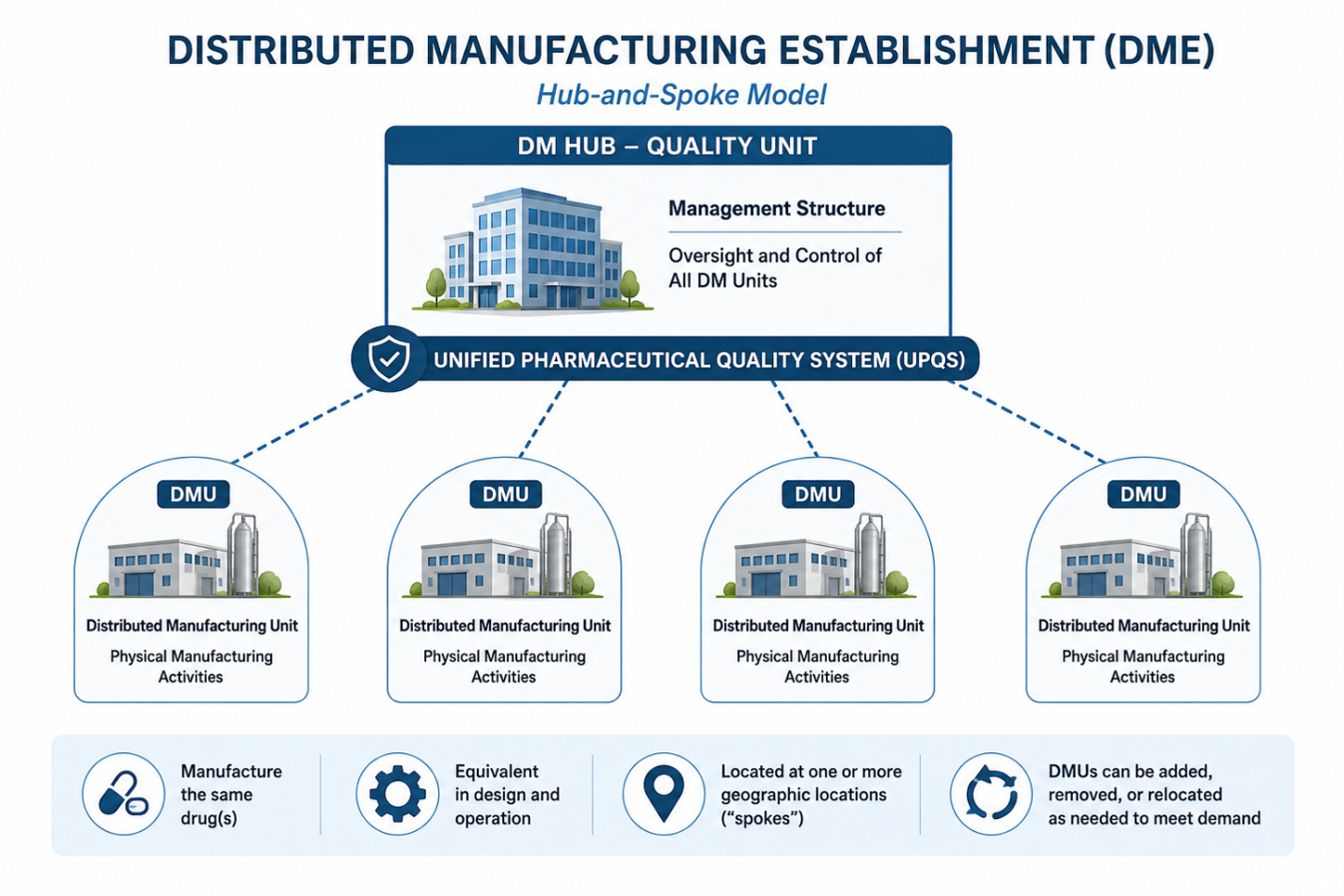
Under the proposal, the DME could register as a single drug manufacturing establishment, even where the DMUs are located in geographically disparate areas. Currently, each DMU and the DM hub3 (if it engages in manufacturing) would be required to register as separate establishments, even where they operate collectively as one establishment.
DME Criteria
A DME comprises a DM hub and one or more DMUs that meet the following criteria:
- The DMUs are demonstrated to be and remain equivalent in design and operation at any location.
- The DMUs engage in the manufacture, preparation, propagation, compounding, or processing of the same drug(s) at one or more physical location(s), under the oversight and control of a single quality unit, which has a management structure located at the DM hub and has implemented a unified pharmaceutical quality system (UPQS).
- Collectively, the hub and DMUs —
- (a) Operate under one management pursuant to a manufacturing strategy designed to be decentralized
- (b) Were subject to a preapproval inspection in connection with an approved marketing application that describes the use of a decentralized manufacturing strategy for at least one drug of each profile class4 manufactured by the distributed manufacturing establishment and is an approved 505(b)(1) or 505(b)(2) NDA, ANDA, new animal drug application (NADA) (or abbreviated applications), or an original biologic license application or biosimilar (i.e., a 351(a) or 351(k) BLA)
- At least one DMU is capable of moving or being moved to another physical location or there are at least two DMUs in the DME if none can be moved.
FDA’s proposal would allow DMEs to manufacture certain products that lack an approved application (such as over-the-counter monograph drugs), provided that each non-application product is the same profile class as one or more drugs manufactured by the DME for an approved application that describes the use of a decentralized manufacturing strategy.
This definition does not permit arrangements where different contract manufacturing organizations are hired to operate a DMU to manufacture the same drug(s) at multiple locations, largely due to potentially differing and competing quality systems which frustrate the ability to ensure that equivalence in design and operations is maintained across the DMUs. Nor are relabelers, repackers, or salvagers that are third parties to the applicant and the manufacturer and do not operate under the ownership or control of the manufacturer eligible for consideration as a DME — they fail to meet the requirement of having the requisite UPQS.
Mechanics
In terms of who must register, how, and when, FDA adapted 21 CFR Part 207 to include DM-specific provisions. For example, proposed sec. 207.17(b) creates a separate registration requirement for DMEs that is similar to the general requirement for establishments in 207.17(a). DM-specific timing requirements for registration are also provided, which are tailored to the hub-and-spoke model of a DME (e.g., registration of a DME no later than five calendar days after the first domestic DMU begins to manufacture a drug for commercial distribution, or before a drug manufactured at any foreign DMU is imported or offered for import into the United States, whichever of the two occurs first). For the information required for registration, the proposal would require similar information in scope to the information currently required for establishment registration, but with differences accounting for the hub-and-spoke model for a DME. For example, FDA proposes assigning the UFI and FDA Establishment Identifier (FEI) to the DM hub and is proposing to require a unique identifier for each DMU (e.g., a sub-FEI number).
FDA notes that an establishment registered as a DME that does not meet the DME requirements (or falls out of compliance such as by a DMU failing to remain equivalent in design and operation to other DMUs in the DME and the registrant does not bring the DMU into equivalence) would not be “duly” registered and drugs manufactured at the establishment would be deemed to be misbranded. Note, FDA intends to provide additional details on complying with cGMPs in an FDA guidance on cGMP considerations for DM that will “assist manufacturers in addressing the complexities associated with DM when complying with FDA’s cGMP requirements (e.g., equivalency, control procedures implemented under a UPQS, and mobile units).”5
Impact
FDA touts the proposed DME registration requirements as benefitting industry, the government, and patients by “increas[ing] visibility into the drug supply chain, as the co-registration of DME hub and spokes would enable FDA to correctly map out each DM configuration and understand the relationships between all components, supporting FDA's efforts to prevent and mitigate drug shortages and respond to unsafe products.”6
Presently, DM is not widespread and FDA concedes it “remains uncertain as to the likely prevalence of distributed manufacturing in the coming years.”7 Its estimated burden for Paperwork Reduction Act of 1995 (PRA) and Preliminary Regulatory Impact Analysis (PRIA) purposes reflects that: FDA assumes zero to two new DMEs in the three years after publication of the final rule, and in subsequent years, FDA projects increased interest with three to five new DMEs in years 4-6 and eight to ten new DMEs in years 7-10.
Foreign Establishment Proposal
The proposed rule is intended to “eliminate any perceived inconsistencies” between section 510 of the Federal Food, Drug, and Cosmetic Act (FD&C Act) and FDA regulations in 21 CFR Part 207. Section 510 of the Federal Food, Drug, and Cosmetic Act (FD&C Act), as amended by the PREVENT Pandemics Act, requires every person who owns or operates any establishment within any foreign country engaged in the manufacture, preparation, propagation, compounding, or processing of a drug that is imported or offered for import into the United States to register its establishment with FDA and list such drugs. Such requirements apply regardless of whether the drug undergoes further manufacture, preparation, propagation, compounding, or processing at a separate establishment outside the United States before being imported or offered for import in the United States.
The amendments would make clarifying changes to FDA’s regulations by expressly requiring establishment registration and product listing for foreign establishments that manufacture, repack, relabel, or salvage a drug that is imported or offered for import into the United States regardless of whether the drug undergoes further manufacture, preparation, propagation, compounding, or processing at a separate foreign establishment before being imported or offered for import into the United States. The current regulations at 21 CFR 207.17(a) do not include this italicized phrase. In addition, FDA stated in the 2016 Registration and Listing Final Regulatory Impact Analysis (FRIA)8 that a foreign API manufacturer that only distributes an API outside of the United States is not required to register even if the finished product manufactured from the API is eventually imported into the United States. These present differences between the statute and the regulations and FDA’s statement could result in confusion about who must register and list — even though it is currently FDA’s position that establishments must register and list if their product undergoes further manufacture, preparation, propagation, compounding, or processing at a separate foreign establishment before being imported or offered for import into the United States because of the self-implementing requirement of section 510 of the FD&C Act.
FDA’s approach is consistent with its perspective on severability. FDA’s stance is that the foreign establishment and drug listing requirements are severable from the DM proposal such that if the rule is finalized and a court determines one or more of the DM provisions to be invalid, that partial invalidation should not render as invalid any of the foreign establishment registration and drug listing provisions. FDA also takes the position that each of the proposed foreign establishment registration and listing provisions may operate independently from one another, and if the application of any portion of such provisions of this rule is determined to be invalid with respect to a particular circumstance, the agency intends that such provisions would remain applicable to all other circumstances.9
Through these amendments, FDA seeks greater visibility into the drug supply chain, anticipates that unregistered foreign firms will more clearly understand their drug establishment registration and product listing obligations, and anticipates increased compliance among covered foreign establishments. FDA also notes that this allows equal application of the registration and listing requirements for foreign and domestic establishments. The practical impact is that, through increased establishment registration and product listing, FDA can exercise more oversight of the drug supply chain. Establishment registration is the primary way for FDA to identify drug manufacturers and is the primary source used to include establishments in FDA’s establishment site selection model that determines routine inspection priority.
The anticipated impact of the foreign establishment registration and listing provisions on industry is higher than for DMEs and is expected to have a greater impact on over-the-counter (OTC) manufacturers. FDA estimates that the proposal will cover about 25 foreign establishments that manufacture a drug subject to an approved application and about 1,600 establishments that manufacture an OTC monograph drug, for a total estimate of 1,313 respondents submitting an initial foreign establishment registration for 1,625 currently unregistered foreign manufacturing establishments. FDA further estimates that these foreign establishments will submit 550 listings for approved products and 24,000 for OTC monograph drugs.
Conclusion
Please contact one of the authors of this Advisory or your regular Arnold & Porter contact if you are interested in discussing the proposed rule or its impact. Comments on the proposed rule are due by September 11, 2026.
© Arnold & Porter Kaye Scholer LLP 2026 All Rights Reserved. This Advisory is intended to be a general summary of the law and does not constitute legal advice. You should consult with counsel to determine applicable legal requirements in a specific fact situation.
-
Drug Establishment Registration and Drug Listing Requirements for Establishments Engaged in Distributed Manufacturing and Certain Foreign Establishments, 91 Fed. Reg. 42888 (July 13, 2026).
-
FDA Actions to Support and Strengthen Domestic Drug Manufacturing (July 10, 2026).
-
A DM hub is the business at one physical location that serves as the primary location of the quality unit responsible for implementing the unified pharmaceutical quality system to direct, monitor, and control the manufacture of drugs to ensure product quality at the DME, including ensuring that all DMUs within the DME at any location are and remain equivalent in design and operation. 91 Fed. Reg. at 42903.
-
Profile class “refers to the categorization of different processing conditions and product types. Immediate-release, delayed-release, and extended-release solid oral dosage forms would be different profile classes of drugs.” 91 Fed. Reg. 42894.
-
-
-
-
Requirements for Foreign and Domestic Establishment Registration and Listing for Human Drugs, Including Drugs That Are Regulated Under a Biologics License Application, and Animal Drugs, Final Regulatory Impact Analysis, Final Regulatory Flexibility Analysis, Unfunded Mandates Reform Act Analysis (Aug. 2016).
-
Key Contacts