DOJ’s FY 2025 FCA Numbers Send a Clear Message: Enforcement Risk Is Rising
The U.S. Department of Justice (DOJ) last week released its annual False Claims Act (FCA) statistics for fiscal year (FY) 2025. The government announced over $6.8 billion in settlements and judgments recovered in the fiscal year ending September 30, 2025, marking the highest total recoveries in a single year in the FCA’s history. This total doubles the $3.1 billion that DOJ recovered in FY24. The results reflect significant DOJ emphasis on FCA enforcement — especially within the healthcare and life sciences industries — coupled with increased whistleblower activity as relators filed a record number of qui tams.
Deputy Attorney General Todd Blanche touted “this record-breaking year proves the False Claims Act remains one of the government’s most powerful weapons against fraud” and promised that DOJ “will continue to aggressively deploy it to protect taxpayer dollars and hold all fraudsters accountable.” So what do the numbers show?
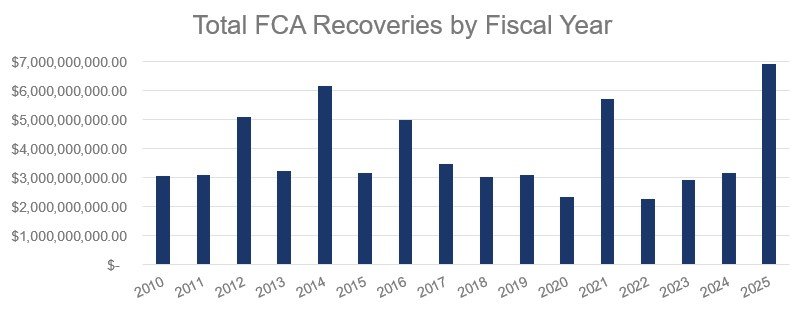
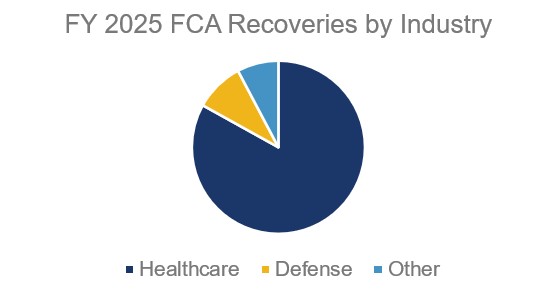
Healthcare and life sciences enforcement dominated FCA recoveries. DOJ reported over $5.7 billion in recoveries in FY25 tied to healthcare matters, compared with $1.8 billion in FY24. Indeed, while the healthcare and life sciences industries generally account for most FCA recoveries, the percentage attributable to healthcare decreased in recent years, including to less than 60% for FY24. That number skyrocketed in FY25, with healthcare and life sciences recoveries accounting for more than 80%.
As reflected in DOJ’s Fact Sheet, three major enforcement areas drove these results: managed care organizations, prescription drugs, and medically unnecessary services. These target areas mirror enforcement priorities announced by the new FCA Working Group last summer, likely reflecting the concentrated efforts of that renewed collaboration between DOJ and the U.S. Department of Health and Human Services.
This boom in healthcare recoveries is a clear message from DOJ and its partner agencies: they are prioritizing FCA enforcement in the life sciences and healthcare space. Providers, payors, and life sciences companies should expect sustained FCA risk in 2026 and beyond.
While healthcare remains central, DOJ’s announcement reinforces the government’s expanding use of the FCA in other contexts as well. DOJ emphasized additional FCA enforcement activity involving government procurement, including defense contracting; cybersecurity compliance obligations applicable to contractors and grantees; and relief programs. DOJ also emphasized recoveries stemming from a new enforcement priority — trade fraud. In 2025, DOJ directed resources to combating trade fraud when it launched a cross-agency Trade Fraud Task Force focused on schemes to evade tariffs and customs duties.
The increase in recoveries last year coincided with a continued rise in whistleblower activity. Despite active challenges to the constitutionality of the qui tam provisions of the FCA, the 2025 statistics underscore the continued significance of whistleblower actions in the government’s FCA recoveries. In FY25, qui tams reached a new high with whistleblowers filing a record 1,297 cases, a substantial increase from a prior recorded high of 980 cases in 2024. And the vast majority of total recoveries — over $5.3 billion — were a result of qui tam-filed cases. Moreover, the 2025 statistics show that the amount of federal funds recovered in cases where DOJ intervened or otherwise pursued the case (approximately $3 billion total) was substantially similar to the amount of money recovered in cases where DOJ declined (approximately $2.3 billion total). This significant recovery by relators in declined cases last year (up from $311 million total in 2024), reflects a relators’ bar that is willing to pursue FCA litigation with or without the support of DOJ, through trial and judgment.
DOJ, for its part, initiated 401 new investigations in 2025, down from 425 cases in 2024 and a record 506 cases in 2023. While a slight decline from immediate years past, this number remains significantly higher than the approximately 260 cases per year average of DOJ-initiated cases from the prior decade, and reflects continued DOJ priority in FCA investigations and the government’s expanding use of data mining. According to DOJ, these DOJ-initiated cases also included administration priority matters outlined in a June 2025 Civil Division Enforcement Memo, such as cases targeting diversity, equity, and inclusion (DEI) practices, antisemitism, gender-affirming care, and immigration practices.
Finally, DOJ reiterated its policy that encourages voluntary self-disclosure, cooperation, and remediation. DOJ emphasized that certain entities and individuals involved in the resolutions last year were credited with reduced penalties or damages multipliers based on these factors, yet failed to specifically identify which recoveries included reductions or how much the penalty or damages figure had been reduced. As DOJ explained, defendants may receive cooperation credit for actions such as self-disclosures, assistance with the determination of government losses, disclosures of internal investigations and facts not known to the government, and remedial measures such as implementing compliance program enhancements or terminating or separating culpable employees.
What’s next? DOJ has made clear that it will continue to deploy the FCA aggressively to advance the administration’s enforcement priorities, reinforcing what we have long counseled clients: FCA risk remains front and center in 2026. We expect both DOJ- and whistleblower-driven cases to track closely with those priorities, including enforcement activity focused on DEI and gender-affirming care, cybersecurity compliance, and trade-related programs. In the healthcare and life sciences sectors, FCA enforcement is likely to remain robust, with continued scrutiny of drug pricing, product safety, kickback arrangements, managed care operations, barriers to patient access, and conduct affecting the integrity of medical records.
For companies, these trends underscore the importance of proactively reassessing compliance programs, internal reporting mechanisms, and audit and documentation practices to ensure they align with evolving enforcement priorities. Early issue identification, disciplined responses to internal complaints, documented remediation, and careful review of government-facing certifications and submissions will be critical to mitigating FCA exposure in the year ahead. Where compliance identifies issues, companies should consider the range of disclosure and cooperation options, as appropriate, to mitigate FCA risk.
© Arnold & Porter Kaye Scholer LLP 2026 All Rights Reserved. This Blog post is intended to be a general summary of the law and does not constitute legal advice. You should consult with counsel to determine applicable legal requirements in a specific fact situation.
Authors